Electric vs Diesel Forklift Cost:
The Ultimate Total Cost of Ownership (TCO) Guide
Executive Summary
Most fleet managers buy equipment backward. They prioritize the sticker price (CapEx) over the lifecycle cost (OpEx).
In material handling, the initial purchase price represents roughly 20% of a machine’s lifetime expense. The remaining 80% is consumed by fuel, charging infrastructure, oil changes, and unexpected mechanical downtime. While an electric forklift unit demands a premium upfront, it systematically starves operational budgets of waste over a typical 5-to-10-year cycle.
This guide provides the raw data to prove that buying electric forklift is no longer just an environmental gesture—it is an aggressive margin-protection strategy.

Upfront CapEx vs. Long-Term OpEx (5 Years)
Industrial data reveals that electric forklifts command a 20% to 40% upfront premium over equivalent internal combustion (IC) diesel trucks.
However, the operational payback loop closes rapidly.
Key Takeaway:
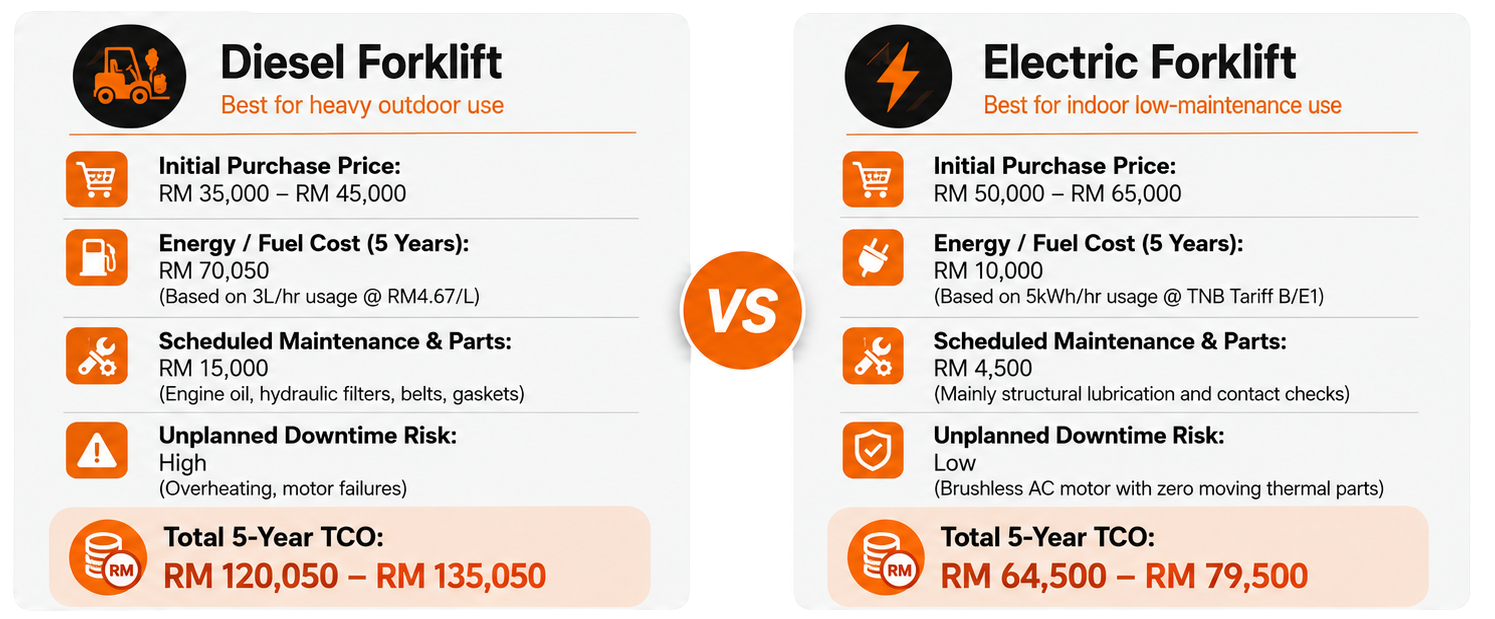
1) The Fuel Reality: Recharging an electric forklift using standard Tenaga Nasional Berhad (TNB) industrial power costs about RM 8.00 per shift. Refueling a diesel truck for the exact same shift will easily drain RM 56.00+ from your wallet.
2) While you pay an extra RM 15,000 upfront for a reconditioned electric model, you recoup that entire variance in less than 12 months purely through diesel savings. If minimizing upfront CapEx is your main priority, securing a flexible forklift for rent is an excellent alternative to capture these immediate energy savings with zero down payment.
3) The Maintenance Mirage: Diesel forklifts need a mechanic’s attention every 250 hours for oil and filter swaps. Electric trucks cross the 1,000-hour mark without needing a single drop of motor oil.
The Raw Breakdown (2.5-Ton Capacity Class)
Fewer Moving Parts Means Fewer Broken Parts
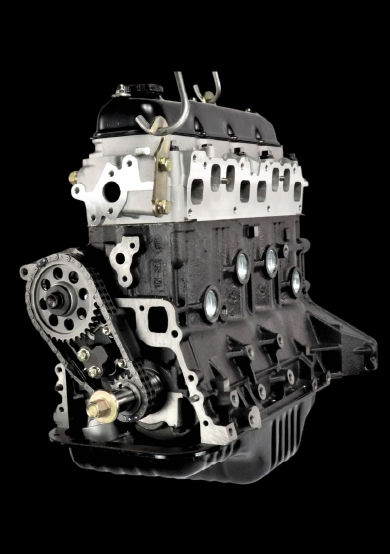
Think of a diesel forklift like a gas-powered lawn mower or a traditional car. Under the hood, it has hundreds of hot, heavy metal pieces slamming together at high speeds. It requires belts, pumps, valves, and fresh oil just to keep from overheating and destroying itself. If even one tiny filter gets clogged or a belt snaps, the whole machine dies. That is the “hidden breakdown tax.”
An electric forklift, on the other hand, is essentially a giant smartphone on wheels. It doesn’t have an engine. It just has a large battery connected to a simple electric motor.
When you strip away the mechanical chaos, the cost of ownership plummets:
- The Parts Count: A diesel engine has over 2,000 components, hundreds of which are constantly moving. An electric motor has about twenty, with only one or two moving parts. There are simply no spark plugs to fail, no radiators to leak, and no exhaust systems to rust.
- The Service Calendar: Because diesel engines burn fuel and create friction, they need a mechanic to change their oil and filters every 250 hours. Electric trucks can easily run for 1,000 hours—four times longer—before needing a basic checkup.
- Cool and Clean: Diesel trucks pump out intense heat and exhaust fumes. In a closed warehouse, that means you have to spend extra money on massive ventilation fans to keep the air safe. Electric trucks run completely cold and silent.
The Bottom Line: When you buy a diesel forklift, you are signing up for a lifelong relationship with a mechanic. Electric cuts out the middleman by choosing a machine that has almost nothing to break in the first place.

Real-World Field Evidence & Case Studies
Case Study: The Heavy Industrial Swap (India’s Vedanta Aluminium)
- The Action: India’s Vedanta Aluminium executed the largest single fleet transition in India by deploying 66 lithium-ion electric forklifts to replace their legacy diesel workhorses.
(Source: Vedanta Aluminium strengthens sustainability efforts, expands India’s largest fleet of electric forklifts) - The Payback: In just 12 months, the switch eliminated 840,000 liters of diesel consumption and slashed carbon emissions by roughly 2,500 tonnes of CO2.
Global logistics data heavily mirrors these savings. When heavy industrial firms execute large-scale fleet transitions from diesel to lithium-ion electric forklifts, the primary driver is almost always the bottom line.
In high-frequency logistics hubs running two or three shifts back-to-back, facilities utilize Opportunity Charging. Instead of waiting hours for a battery to charge, operators simply plug the electric trucks into fast-chargers during 15-minute tea breaks and lunch hours. This keeps the battery topped up all day, completely eliminating the old need for dedicated battery-changing rooms or messy on-site diesel storage tanks.

The Reconditioned Strategy: The Ultimate Budget Shortcut
If you manage a Malaysian warehouse, the data presents a clear winner. But what if your business doesn’t want to invest RM 65,000+ upfront for a brand-new electric setup?
This is where the reconditioned market shines. By opting for a premium, Japanese-imported reconditioned forklifts, you get the best of both worlds:
- You completely bypass the steep upfront price tag of a brand-new machine.
- You immediately capture the massive, RM 12,000-per-year fuel and maintenance savings that electric technology provides.
When you buy a diesel forklift, you are signing up for a lifelong financial relationship with fuel suppliers and mechanics. Choosing a reconditioned electric forklift cuts out the middleman, keeping your operational capital exactly where it belongs—in your business.